

 830
 19 minutes read
Contents
- Tokyo
- Worth the train ride out of Tokyo
- Central Japan
- Kansai and west
- Itinerary ideas
- Practical notes
- Where to stay
- FAQ
- Ordinary places, extraordinary fandom
Tokyo
Suga Shrine, Yotsuya, the Your Name staircase
The stone staircase with the red handrail near Suga Shrine is the closing scene of Makoto Shinkai’s “Your Name” (Kimi no Na wa), and it is real, sitting in an ordinary residential street in Yotsuya. The shrine itself dates to the Edo period and is dedicated to Susanoo-no-Mikoto and his wife, worth a quiet visit in its own right rather than only a photo stop.
- Cost: Free.
- Getting there: A short walk from Yotsuya-Sanchōme Station on the Marunouchi line, or Yotsuya Station on the JR Chūō line.
- Time to allow: 20 to 30 minutes.
- The honest catch: this is a residential street with people’s actual homes at the foot of the stairs. Morning visits tend to be quieter, photos are fine, but lingering, sitting on neighbours’ steps, or raising voices are the sort of things that wear out a neighbourhood’s patience with fans fairly quickly.

The stone staircase with the red handrail near Suga Shrine is the closing scene of Makoto Shinkai’s Your Name.
Photo by Gengorou on Shutterstock
Shinjuku, Yoyogi, and the Shinkai skyline
Makoto Shinkai’s films, “Your Name,” “Weathering With You,” and “Suzume” among them, draw repeatedly on Shinjuku’s skyline, including the distinctive curved silhouette of the Docomo Tower near Yoyogi. None of this is a single site to visit so much as a backdrop that clicks into place once a visitor has spent an afternoon in the area. Shinjuku itself, with its station complexity and neon density, is worth the wander regardless of the anime connection.

Docomo Tower near Yoyogi.
Photo by Mistervlad on Shutterstock
Shibuya, and the Jujutsu Kaisen connection
Shibuya Crossing needs no introduction, it recurs across more anime and film than any other single Tokyo location. It also carries a more specific real-world tie for newer fans: Jujutsu Kaisen’s Shibuya Incident arc is set directly in and around Shibuya Station and its surrounding streets, using the district’s actual density and layout rather than a fictional stand-in. The crossing and station area are freely visitable and cost nothing, and the honest note here is that the anime heightens and darkens the setting considerably, so a daytime visit looks like ordinary, busy Shibuya rather than anything close to the show’s tone.

Jujutsu Kaisen’s Shibuya Incident arc is set directly in and around Shibuya Station and its surrounding streets.
Photo by seaonweb on Shutterstock
Akihabara
Akihabara’s reputation as an otaku district is decades old, and the area has shifted since: it is now as much about electronics retail and mainstream tourism as it is about anime and manga specifically, though the anime and gaming stores remain a real draw. For a visitor with two hours rather than a full day, the Animate flagship store, a multi-floor electronics store like Yodobashi Camera, and a wander down the main strip past the maid café touts covers the essentials without needing to commit to a specialist collector’s itinerary.
- Cost: Free to browse; individual purchases vary widely.
- Getting there: Akihabara Station, JR Yamanote and several other lines.
- Time to allow: Two hours for a casual visit, a full day for serious shopping.

Akihabara’s reputation as an otaku district is decades old.
Photo by VTT Studio on Shutterstock
Nakano Broadway
Many long-time fans prefer Nakano Broadway to Akihabara specifically because it feels less tourist-oriented: a shopping complex a short walk from Nakano Station, dense with small specialist shops selling vintage figures, retro manga, and collectibles that Akihabara’s larger stores do not always stock. It suits a visitor who wants the collector’s experience without the crowds.

Nakano Broadway — a shopping complex a short walk from Nakano Station, dense with small specialist shops.
Photo by Japan Still on Shutterstock
Ikebukuro and Otome Road
Ikebukuro’s Otome Road is Akihabara’s counterpart aimed at a different audience, built around shops, cafés, and merchandise for shoujo manga and female-oriented fandoms. It is a smaller, more walkable stretch than Akihabara and worth an hour or two for anyone whose interests sit in that direction.

It is a smaller, more walkable stretch than Akihabara.
Photo by Japan Still on Shutterstock
Meidaimae, for One Punch Man
Saitama’s apartment street is a real one. Fans have identified a residential building in Meidaimae, in Tokyo’s Setagaya ward, as the model for the apartment in “One Punch Man,” and the streets around it look very close to the anime. The show’s own Z-City is fictional, so the connection is to this one corner of Setagaya rather than to a whole town. The building is a private home, so only the exterior and the street can be seen. Meidaimae Station, on the Keio and Keio Inokashira lines, is a few minutes by train from both Shinjuku and Shibuya, and the street is around a seven-minute walk from the station. Visiting is free and 20 to 30 minutes is plenty.

Saitama’s apartment street is a real one.
Photo by cowardlion on Shutterstock
The Ghibli Museum, Mitaka
The Ghibli Museum sits in Mitaka, a quiet part of west Tokyo, and it is a genuinely different experience from Ghibli Park in Aichi, small, intimate, and built around Hayao Miyazaki’s own design sensibility rather than a large-scale theme park. The two are commonly confused, and they are not interchangeable: different tickets, different cities, different scale.
- Booking: Advance reservation only, no walk-up tickets. Two official overseas routes exist: the English-language Lawson Ticket site, which releases the following month’s tickets at 10:00 a.m. Japan time on the 10th of each month, and a Sunrise Tours (JTB) bus tour bundling the museum with a nearby architecture museum for anyone who would rather skip the release-day scramble.
- Cost: A set ticket price, confirmed at booking through the official channel.
- Getting there: No on-site parking; arrive by train to Mitaka Station, then a short walk or the museum’s shuttle bus.
- Time to allow: Around two to three hours.

The Ghibli Museum — small, intimate, and built around Hayao Miyazaki’s own design sensibility.
Photo by cowardlion on Shutterstock
Worth the train ride out of Tokyo
Kamakura and the Slam Dunk crossing
The railway crossing beside Kamakurakōkōmae Station on the small coastal Enoden line is the real location behind Slam Dunk’s iconic opening sequence, an Enoden train passing with the Shōnan coast behind it. It has become one of the most visited anime pilgrimage sites anywhere, and that popularity has created real friction with the surrounding residential neighbourhood.
- Cost: Free; the Enoden line itself charges standard train fares.
- Getting there: About an hour from central Tokyo by JR and Enoden lines to Kamakurakōkōmae Station.
- Time to allow: 20 minutes at the crossing itself, best folded into a longer day along the Enoden line toward Enoshima.
- The honest catch: Kamakura City has introduced active crowd-management measures here, including monitoring and multilingual signage, because visitors stepping onto the tracks for photos has been a genuine safety problem. Arriving early in the day, taking photos quickly, and following any posted instructions keeps the site workable for everyone, residents included.
ZenHotels Insight
Visiting the crossing at first light generally means an earlier departure from Tokyo than public transport comfortably allows, so a Kamakura or Enoshima-area stay the night before is worth considering for anyone set on catching it quiet.

The railway crossing beside Kamakurakōkōmae Station on the small coastal Enoden line is the real location behind Slam Dunk’s iconic opening sequence.
Photo by cowardlion on Shutterstock
Chichibu, for Anohana
Chichibu, in Saitama Prefecture, is the real setting behind “Anohana: The Flower We Saw That Day”, and the show draws closely on the town’s actual streets, shrine, and surrounding hills rather than an invented backdrop. It suits a fan of that specific series more than a general anime-tourism stop, reachable from Tokyo via the Seibu line in roughly 90 minutes.

Chichibu, in Saitama Prefecture, is the real setting behind Anohana: The Flower We Saw That Day.
Photo by OFFICE TK on Shutterstock
Hakone and the Fuji Five Lakes
Hakone and the Fuji Five Lakes area appear, directly or as clear inspiration, across a wide range of series set against Mount Fuji, and the region works as a worthwhile day trip or overnight regardless of any specific anime tie, given the onsen culture and Fuji views on a clear day.

Hakone and the Fuji Five Lakes area appear, directly or as clear inspiration, across a wide range of series set.
Photo by PhotoNetwork on Shutterstock
Nikko or Kawagoe, the “old Japan” backdrop
Nikko’s shrines and Kawagoe’s preserved Edo-period streets both recur as the generic “old Japan” setting across a wide range of series, without either being tied to one specific title the way Suga Shrine or the Kamakura crossing are. Kawagoe is the more convenient of the two from central Tokyo, under an hour by train.

Nikko’s shrines and Kawagoe’s preserved Edo-period streets both recur as the generic “old Japan”.
Photo by Gengorou on Shutterstock
Central Japan
Ghibli Park, Aichi Prefecture
Ghibli Park sits inside the Expo 2005 Aichi Commemorative Park, a short train ride from Nagoya, and it is a full theme park spread across five areas: Ghibli’s Grand Warehouse, Hill of Youth, Dondoko Forest, Mononoke Village, and Valley of Witches. This is a completely different scale of experience from the Ghibli Museum, and staying in Nagoya rather than day-tripping from Tokyo makes considerably more sense given the travel time involved.
- Booking: Advance ticket only, no gate sales. Tickets for a given month go on sale on the 10th of the month two months prior, at 2:00 PM Japan time, first-come-first-served rather than a lottery. Overseas visitors can buy through Klook, which accepts international cards and issues an e-voucher, or the English Lawson Ticket site directly.
- Cost: Varies by pass type: single-area passes exist for those wanting only part of the park, and a Premium pass covering all five areas costs more but removes the need to plan around a single assigned entrance time.
- Getting there: From Nagoya, the Higashiyama subway line to Fujigaoka, then the Linimo line roughly 13 minutes to Ai-Chikyuhaku-kinen-koen Station, about 35 to 45 minutes total.
- Time to allow: A full day.
ZenHotels insight
Since Ghibli Park tickets release two months ahead on a fixed date, booking a flexible-cancellation room in Nagoya for that window before the ticket sale even opens protects the trip if the exact date shifts once tickets actually go live.

Ghibli Park sits inside the Expo 2005 Aichi Commemorative Park, a short train ride from Nagoya, and it is a full theme park.
Photo by Softvisual on Shutterstock
Hida-Furukawa and Takayama, for Your Name
Hida-Furukawa, near Takayama in Gifu Prefecture, provided visual inspiration for the fictional town of Itomori in “Your Name,” particularly its train station and the surrounding mountain scenery. It is not a one-to-one match the way Suga Shrine is, more an atmosphere and specific architectural details than an exact frame, and the town is worth visiting on its own merits as a well-preserved traditional area regardless of the anime connection.

Hida-Furukawa, near Takayama in Gifu Prefecture, provided visual inspiration for the fictional town of Itomori in “Your Name”.
Photo by beibaoke on Shutterstock
Shirakawa-go, for Higurashi and beyond
Shirakawa-go’s UNESCO-listed thatched-roof gasshō-zukuri farmhouses inspired the setting of Higurashi: “When They Cry,” among other series drawn to its distinctive mountain-village look. It stands entirely on its own as a destination too, one of the most visually striking rural areas in Japan regardless of any anime tie, reachable by bus from Takayama or Kanazawa.

Shirakawa-go’s UNESCO-listed thatched-roof gasshō-zukuri farmhouses inspired the setting of Higurashi: “When They Cry”.
Photo by Sean Pavone on Shutterstock
Kansai and west
Kyoto: Fushimi Inari, the Kamo River, and Kyoto’s historical layer
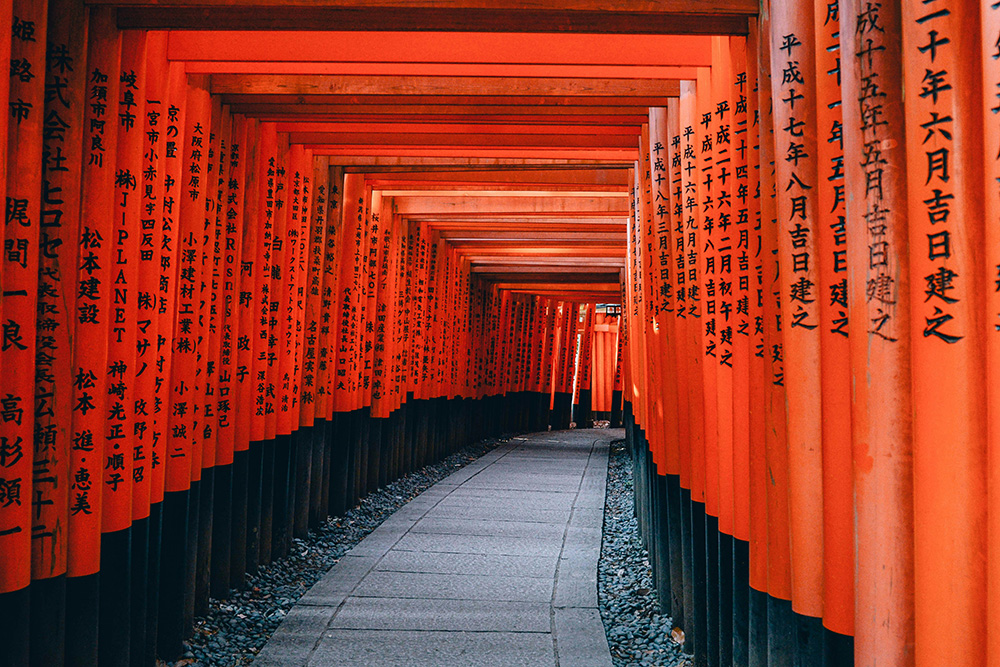
Fushimi Inari Taisha’s thousands of vermilion torii gates climbing Mount Inari are one of Kyoto’s most photographed sights on their own terms, and the mountain-shrine setting has drawn repeated comparison to Demon Slayer’s demon-hunting territories, a spirit-inhabited peak reached only via a marked path through narrowing gates. This is closer to atmospheric inspiration than a direct frame match, worth stating plainly rather than overselling the connection.
- Cost: Free, open 24 hours.
- Getting there: JR Inari Station, five minutes from Kyoto Station on the Nara line.
- Time to allow: 90 minutes for the main gates and the Yotsutsuji viewpoint roughly halfway up; a full ascent to the summit adds another hour or so each way.
The Kamo River running through central Kyoto, along with the Kyoto International Manga Museum and the general downtown area, recur as a loose backdrop across series including K-On!, more mood than specific frame.
Kyoto also carries a real historical layer that older-generation fans will recognise: “Rurouni Kenshin”, released in some markets as “Samurai X”, is set partly in Kyoto during the Bakumatsu period, and several of the districts the series draws on, including areas around Gion and the Shinsengumi’s historical presence in the city, are real and walkable today, though reshaped considerably by the century and a half since.
A genuine warning on Gion
Gion is not off-limits to tourists, but Kyoto authorities have restricted access to some of its private alleyways in response to overcrowding and disruptive behaviour affecting the geisha and maiko community and local residents. Sticking to the main streets, following posted signage, and not following or photographing geisha up close are not optional courtesies here, they are the current rules, and Gion’s continued openness to visitors depends on people actually following them.
Osaka
Osaka sits about 15 minutes from Kyoto by train and generally runs cheaper for accommodation, which makes it a genuinely reasonable alternative base for anyone splitting time between the two cities. Den Den Town is Osaka’s answer to Akihabara, smaller and less crowded, and Universal Studios Japan runs periodic anime collaborations and attractions worth checking against the current schedule before a visit, since these rotate.

Den Den Town is Osaka’s answer to Akihabara, smaller and less crowded.
Photo by note thanun on Unsplash
Miyagi and the honest Haikyuu note
“Haikyuu!!” sets its fictional Karasuno High School in Miyagi Prefecture, and while the town itself is invented, the series draws general atmosphere from the real prefecture and its main city, Sendai. This is a looser connection than most entries in this guide, there is no single confirmed real-world Karasuno to visit, so it suits a fan already planning a Tohoku detour more than a dedicated pilgrimage destination on its own.

“Haikyuu!!” draws general atmosphere from the real prefecture and its main city, Sendai.
Photo by OTTO-FOTO on Shutterstock
Onomichi and Hiroshima
Onomichi’s hillside streets and coastal views have appeared across a range of series drawn to its distinctive small-city geography, and it pairs naturally with a Hiroshima visit for anyone with extra time in the region.

Onomichi’s hillside streets and coastal views have appeared across a range of series drawn to its distinctive small-city geography.
Photo by DavidLeung6453 on Shutterstock
Itinerary ideas
1. One day in Tokyo, anime-focused: Suga Shrine in the morning, Shinjuku for lunch and the skyline, Akihabara or Nakano Broadway in the afternoon, Shibuya Crossing in the evening.
2. Five days in Tokyo plus one day trip: the Tokyo day above, a second day covering Ikebukuro, Odaiba, and the Ghibli Museum, a third day free for other Tokyo interests, and a fourth day out to Kamakura for the “Slam Dunk” crossing, with a fifth day held flexible.
3. A ten-day Tokyo, Nagoya, Kyoto route: the Tokyo days above, then Nagoya for a full day at Ghibli Park, then on to Kyoto for Fushimi Inari, the Kamo River area, and a careful, respectful pass through Gion, with Osaka as an optional add-on given the short train ride.
4. What to book before leaving home, and in what order: Ghibli Park and Ghibli Museum tickets first, since both release on a fixed monthly schedule and popular dates sell out within minutes, followed by any peak-season accommodation, then everything else can be arranged closer to the trip.

One day in Tokyo, anime-focused: Suga Shrine in the morning, Shinjuku for lunch.
Photo by Teodor Kuduschiev on Unsplash
Practical notes
- Transport. A rechargeable IC card, Suica or Pasmo, covers trains, subways, and buses across nearly every city in this guide and removes the need to buy individual tickets for short hops. Whether a JR Pass is worth it depends heavily on the specific route: a Tokyo-Nagoya-Kyoto itinerary with a couple of shinkansen legs can make a pass worthwhile, while a Tokyo-only trip generally does not need one at all, since city transport isn’t covered by the national rail pass in the way visitors sometimes assume.
- Best season. Spring cherry blossom season and autumn foliage are both beautiful and also the most heavily booked periods of the year, with hotel inventory in Kyoto and near Ghibli Park selling out months ahead. A visitor with flexible dates finds considerably more availability, and often a calmer experience at sites like Fushimi Inari, outside those two windows.
ZenHotels Insight
Cherry blossom and autumn foliage weeks are when Kyoto and Nagoya hotel inventory disappears fastest, so locking in accommodation before booking flights, rather than after, avoids losing a well-located base to someone who booked earlier.
- Budget. Costs vary by pace and comfort level, but transport, entry where applicable, and food add up faster in Kyoto and Tokyo than in smaller stops like Chichibu or Hida-Furukawa. The two must-book items, Ghibli Park and the Ghibli Museum, both carry modest ticket prices relative to the rest of a Japan trip’s costs.
- Visiting respectfully. Several of these locations are working shrines, active railway crossings, or ordinary residential streets, not attractions built for visitors. Keeping voices down near Suga Shrine, moving quickly and safely at the Kamakura crossing, and following Gion’s current access rules are the difference between fan enthusiasm that neighbourhoods tolerate and the kind that leads to more restrictions for everyone who visits after.

Spring cherry blossom season and autumn foliage are both beautiful and also the most heavily booked periods of the year.
Photo by Syadza Salsabyla on Unsplash
Where to stay
Grouped by the bases the itinerary above actually uses.
Tokyo
Shinjuku puts Suga Shrine, the skyline views, and onward transport to day trips within easy reach; Akihabara and Ikebukuro suit visitors prioritising those specific districts.
Compare more hotels in Japan on ZenHotels to check current availability.
Nagoya, for Ghibli Park
Staying overnight in Nagoya rather than day-tripping from Tokyo cuts hours off the day and leaves room for a relaxed, full day at the park.
Kyoto
Central Kyoto puts Fushimi Inari’s station, the Kamo River, and Gion within easy reach on foot or a short subway ride.
Note that Japanese hotel rooms, across every budget level in this guide, run smaller than equivalent categories in North America or parts of Europe. This is standard across the country rather than a mark against any specific property.
FAQ
Ordinary places, extraordinary fandom
Most of the famous frames turn out to be ordinary places, a staircase, a level crossing, a stretch of river, and that ordinariness is exactly what makes standing in front of them feel worthwhile. The two things genuinely worth booking months ahead are Ghibli Park and the Ghibli Museum, both running on fixed monthly release schedules that sell out fast; almost everything else on this list can be improvised once in Japan. Comparing hotels in Tokyo, Nagoya, and Kyoto and picking a convenient base for each leg is a reasonable place to start turning this into an actual trip on ZenHotels.


